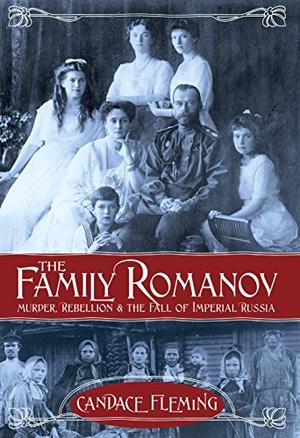
Title: The Family Romanov: Murder, Rebellion, and the Fall of Imperial Russia
Author: Candace Fleming
Publisher: Schwartz & Wade Books
Publication Date: July 8, 2014
ISBN: 978-0375867828
PLOT SUMMARY
The Family Romanov is a biography of Tsar Nicholas II of Russia and his family, the last monarchs of imperial Russia. Fleming chronicles the upbringing of Nicholas and his wife, Empress Alexandra, their rise to power, and the births and childhood of their children, the Grand Duchesses Olga, Tatiana, Marie, and Anastasia, and Tsarevich Alexei, the heir to the throne who tragically suffered from hemophilia. The rulers were reluctant and poorly prepared for the power of the monarchy and consistently isolated themselves and their family from others. Desperate to heal their son, the deeply religious Alexandra put her and her family's full trust in the corrupt mystic Rasputin, who often manipulated political decisions and appointments. The monarchs were oblivious and ignorant towards the suffering of the poor masses that made up most of Russia, and Fleming juxtaposes the opulent lives of the monarchs to accounts of starving peasants, members of the working class, and soldiers in World War I, as well as accounts of the workers' strikes and Lenin's rise to power within the Russian Social Democratic Party. These first-person accounts add context to the history of the fall of the Russian empire, leading up to the Romanovs final days before their tragic murders.
CRITICAL ANALYSIS
Fleming is a multiple award-winning author of biographies about historical figures, including Charles Lindbergh, Buffalo Bill, Amelia Earhart, P.T. Barnum, Abraham and Mary Lincoln, Eleanor Roosevelt, and Benjamin Franklin. In the bibliography, Fleming described her research process, which included speaking with Russian scholars and access to original sources from the State Archive of the Russian Federation (GARF) and Harvard's Houghton Library (Fleming, 2014, pp. 356-358). Fleming's enthusiasm even extended to a trip to Russia so she could view various physical locations, including the palaces of the Romanov's, Rasputin's last apartment, and Lenin's headquarters. Fleming explained that the fall of the Soviet Union in 1991 triggered the release of primary sources that were hidden away by the Communist Party, changing the history of what had been known about the fall of the Russian empire. Before these sources were discovered, the history of the imperial family was "sympathetic, painting an overly rosy picture" (Fleming, 2014, pp. 257). Fleming meticulously documents the primary sources she used, which do not shy away from describing the faults of the imperial family, as well as the general sources from historians. The back of the book includes a comprehensive list of documents that dialogue was sourced from (Fleming, 2014, pp. 267-287). Fleming's research is purely fact and does not focus on theory. For example, she spent only two short paragraphs on people who claimed to be surviving imperial children but did not describe details about those people. She quickly explained that they were imposters. (Fleming, 2014, pp. 243-244).
CRITICAL ANALYSIS
Fleming is a multiple award-winning author of biographies about historical figures, including Charles Lindbergh, Buffalo Bill, Amelia Earhart, P.T. Barnum, Abraham and Mary Lincoln, Eleanor Roosevelt, and Benjamin Franklin. In the bibliography, Fleming described her research process, which included speaking with Russian scholars and access to original sources from the State Archive of the Russian Federation (GARF) and Harvard's Houghton Library (Fleming, 2014, pp. 356-358). Fleming's enthusiasm even extended to a trip to Russia so she could view various physical locations, including the palaces of the Romanov's, Rasputin's last apartment, and Lenin's headquarters. Fleming explained that the fall of the Soviet Union in 1991 triggered the release of primary sources that were hidden away by the Communist Party, changing the history of what had been known about the fall of the Russian empire. Before these sources were discovered, the history of the imperial family was "sympathetic, painting an overly rosy picture" (Fleming, 2014, pp. 257). Fleming meticulously documents the primary sources she used, which do not shy away from describing the faults of the imperial family, as well as the general sources from historians. The back of the book includes a comprehensive list of documents that dialogue was sourced from (Fleming, 2014, pp. 267-287). Fleming's research is purely fact and does not focus on theory. For example, she spent only two short paragraphs on people who claimed to be surviving imperial children but did not describe details about those people. She quickly explained that they were imposters. (Fleming, 2014, pp. 243-244).
The table of contents clearly lists the four parts of the book and the chapters included, as well as each instance of Beyond the Palace Gates, first-person accounts from peasants, soldiers, and factory workers. These accounts are clearly distinguished from the accounts about the Romanovs in the text, as they are enclosed in decorative light gray boxes. The book follows a clear, chronological sequence, from 1881 to 1918, and then 1976 to 2007 when the remains of the Romanovs were discovered. The layout is logical, breaking up chapters into sections to make it easier to follow the book, which otherwise might have seemed intimidating to tackle at 292 pages. These sections have clear titles that describe what that section will be about. The only interruptions to this layout are the sections containing photographs. The photographs for parts one and two of the book are inserted between chapters nine and ten in part three, and the photographs for parts three and four and inserted in the middle of the last chapter of the book, interrupting a paragraph for sixteen pages. This might have been a printer decision, as the photographs are printed on slick paper that is heavier than the other paper used in the book, and may have needed to be stitched and bound to specific areas of the book spine. This slick paper helps provide clarity and detail to the various photos included, which showcase many moments mentioned in the book, such as Nicholas declaring war on the balcony of the Winter Palace in 1914, soldiers in trenches, the royal family, Lenin, protestors, the House of Special Purpose that the Romanovs were imprisoned at and even a photo of Rasputin, alive and dead.
Various other reference aids are also included. The book is preceded by a note about the titles of the imperial family and Russian naming conventions to help readers understand ranks and names. A simplified family tree is included to help readers keep track of Nicholas and Alexandra's family members, as well as symbols marking hemophilia carriers and hemophiliacs in the family. A map of the Russian empire can help readers understand how much larger Russia was during Nicholas's reign, which included land that now makes up the countries of Finland, Estonia, Latvia, Lithuania, Belarus, Ukraine, Poland, Moldova, Kazakhstan, Georgia, Armenia, Azerbaijan, Turkmenistan, Uzbekistan, Kyrgyzstan, and Tajikistan. Fleming also included a list of websites for further recommended reading, which include virtual tours, family photographs, home movies, and even the recorded funeral of the Romanovs in 1998 (Fleming, 2014, pp. 266).
AWARDS
2015 NCTE Orbis Pictus Award for Outstanding Nonfiction
2015 Boston Globe-Horn Book Award for Nonfiction
2015 Golden Kite Award for Nonfiction
2015 Los Angeles Times Book Prize for Young Adult Literature
2015 ALA Notable Books for Children, Older Readers
2015 Robert F. Sibert Informational Book Honor
2015 YALSA Excellence in Nonfiction Award Finalist
2014 Cybils Awards winner, Nonfiction for Young Adults
REVIEW EXCERPTS
“For readers who regard history as dull, Fleming’s extraordinary book is proof positive that, on the contrary, it is endlessly fascinating, absorbing as any novel, and the stuff of an altogether memorable reading experience.” - Booklist, starred review
“Fleming has outdone herself with this riveting work of narrative nonfiction that appeals to the imagination as much as the intellect.” - The Horn Book, starred review
“A solid resource and good recreational reading for high school students.” - School Library Journal, starred review
2015 NCTE Orbis Pictus Award for Outstanding Nonfiction
2015 Boston Globe-Horn Book Award for Nonfiction
2015 Golden Kite Award for Nonfiction
2015 Los Angeles Times Book Prize for Young Adult Literature
2015 ALA Notable Books for Children, Older Readers
2015 Robert F. Sibert Informational Book Honor
2015 YALSA Excellence in Nonfiction Award Finalist
2014 Cybils Awards winner, Nonfiction for Young Adults
REVIEW EXCERPTS
“For readers who regard history as dull, Fleming’s extraordinary book is proof positive that, on the contrary, it is endlessly fascinating, absorbing as any novel, and the stuff of an altogether memorable reading experience.” - Booklist, starred review
“Fleming has outdone herself with this riveting work of narrative nonfiction that appeals to the imagination as much as the intellect.” - The Horn Book, starred review
“A solid resource and good recreational reading for high school students.” - School Library Journal, starred review
“A remarkable human story, told with clarity and confidence.” - Kirkus Reviews, starred review
“Making vibrant use of primary sources that emerged since the collapse of the Soviet Union in 1991, Fleming (Amelia Lost) brings to life the last imperial family of Russia... A wonderful introduction to this era in Russian history and a great read for those already familiar with it.” - Publishers Weekly, starred review
“With comprehensive source notes and bibliographies of print and online materials, this will be a boon to student researchers, but it’s also a heartbreaking page-turner for YAs who prefer their nonfiction to read like a novel.” - The Bulletin of the Center for Children's Books, starred review
“Fans of Candace Fleming (The Lincolns; The Great and Only Barnum), widely recognized for her scholarly, engaging nonfiction, will immediately notice something different about The Family Romanov. It is not filled with sidebars or artifacts that leap off the page. This fascinating, handsome book is about words--not only the author's narrative, but those of the people who lived the events.” - Shelf Awareness, starred review
“In this superb history for readers ages 12-16, Ms. Fleming draws on a rich mixture of sources to capture the caprice, despotism and human fragility of the uxorious last Czar of All the Russias.” - The Wall Street Journal
“This story of Russia’s final czar (pronounced “zar”), or leader, and his family has all the elements of a fictional thriller—political repression, figures of evil, a drawn-out war, endangered children—but they are woven into a fascinating work of history.” - Washington Post
“With comprehensive source notes and bibliographies of print and online materials, this will be a boon to student researchers, but it’s also a heartbreaking page-turner for YAs who prefer their nonfiction to read like a novel.” - The Bulletin of the Center for Children's Books, starred review
“Fans of Candace Fleming (The Lincolns; The Great and Only Barnum), widely recognized for her scholarly, engaging nonfiction, will immediately notice something different about The Family Romanov. It is not filled with sidebars or artifacts that leap off the page. This fascinating, handsome book is about words--not only the author's narrative, but those of the people who lived the events.” - Shelf Awareness, starred review
“In this superb history for readers ages 12-16, Ms. Fleming draws on a rich mixture of sources to capture the caprice, despotism and human fragility of the uxorious last Czar of All the Russias.” - The Wall Street Journal
“This story of Russia’s final czar (pronounced “zar”), or leader, and his family has all the elements of a fictional thriller—political repression, figures of evil, a drawn-out war, endangered children—but they are woven into a fascinating work of history.” - Washington Post
Enrichment activities: Author Candace Fleming included several resources for educators on her website https://www.candacefleming.com/books/bk_romanov.html (Fleming, n.d.). The website includes an educator guide with several discussion questions and curriculum connection activities, a podcast interview with Fleming discussing her process researching the book, and an entertaining book trailer that can be shared with readers, especially before reading the book.
Related books:
Gelardi, J. P. (2011). From Splendor to Revolution: The Romanov Women, 1847-1928. St. Martin's Press.
Related books:
Gelardi, J. P. (2011). From Splendor to Revolution: The Romanov Women, 1847-1928. St. Martin's Press.
ISBN: 978-0312371159
Mironenko, S., & Maylynas, A. (1997). A Lifelong Passion: Nicholas and Alexandra: Their Own Story. Doubleday.
ISBN: 978-0385486736
Rappaport, H. (2018). The Race to Save the Romanovs: The Truth Behind the Secret Plans to Rescue the Russian Imperial Family. St. Martin's Press.
ISBN: 978-1250151216
Rappaport, H. (2017). Caught in the Revolution: Petrograd, Russia, 1918 - A World on the Edge. St. Martin's Press.
ISBN: 978-1250056641
Rappaport, H. (2014). The Romanov Sisters: The Lost Lives of the Daughters of Nicholas and Alexandra. St. Martin's Press.
ISBN: 978-1250020208
Rappaport, H. (2009). The Last Days of the Romanovs: Tragedy at Ekaterinburg. St. Martin's Press.
ISBN: 978-0312379766
Smith, D. (2016). Rasputin: Faith, Power, and the Twilight of the Romanovs. Farrar, Straus, and Giroux.
ISBN: 978-0374240844
Vorres, I. (2001). The Last Grand Duchess: The Memoirs of Grand Duchess Olga Alexandrovna. Key Porter Books.
ISBN: 978-1552633021
REFERENCES
Fleming, C. (n.d.) The Family Romanov: Murder, Rebellion, and the Fall of Imperial Russia. Candace Fleming. https://www.candacefleming.com/books/bk_romanov.html
Fleming, C. (2014). The Family Romanov: Murder, Rebellion, and the Fall of Imperial Russia. Schwartz and Wade Books.


No comments:
Post a Comment