Saturday, March 28, 2020

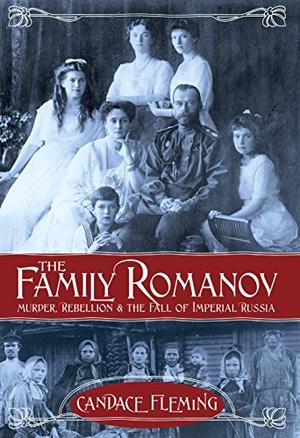
Book Review: The Family Romanov: Murder, Rebellion, and the Fall of Imperial Russia


THE FAMILY ROMANOV
BIBLIOGRAPHY
Title: The Family Romanov: Murder, Rebellion, and the Fall of Imperial Russia
Author: Candace Fleming
Publisher: Schwartz & Wade Books
Publication Date: July 8, 2014
ISBN: 978-0375867828


PLOT SUMMARY
The Family Romanov is a biography of Tsar Nicholas II of Russia and his family, the last monarchs of imperial Russia. Fleming chronicles the upbringing of Nicholas and his wife, Empress Alexandra, their rise to power, and the births and childhood of their children, the Grand Duchesses Olga, Tatiana, Marie, and Anastasia, and Tsarevich Alexei, the heir to the throne who tragically suffered from hemophilia. The rulers were reluctant and poorly prepared for the power of the monarchy and consistently isolated themselves and their family from others. Desperate to heal their son, the deeply religious Alexandra put her and her family's full trust in the corrupt mystic Rasputin, who often manipulated political decisions and appointments. The monarchs were oblivious and ignorant towards the suffering of the poor masses that made up most of Russia, and Fleming juxtaposes the opulent lives of the monarchs to accounts of starving peasants, members of the working class, and soldiers in World War I, as well as accounts of the workers' strikes and Lenin's rise to power within the Russian Social Democratic Party. These first-person accounts add context to the history of the fall of the Russian empire, leading up to the Romanovs final days before their tragic murders.

CRITICAL ANALYSIS
Fleming is a multiple award-winning author of biographies about historical figures, including Charles Lindbergh, Buffalo Bill, Amelia Earhart, P.T. Barnum, Abraham and Mary Lincoln, Eleanor Roosevelt, and Benjamin Franklin. In the bibliography, Fleming described her research process, which included speaking with Russian scholars and access to original sources from the State Archive of the Russian Federation (GARF) and Harvard's Houghton Library (Fleming, 2014, pp. 356-358). Fleming's enthusiasm even extended to a trip to Russia so she could view various physical locations, including the palaces of the Romanov's, Rasputin's last apartment, and Lenin's headquarters. Fleming explained that the fall of the Soviet Union in 1991 triggered the release of primary sources that were hidden away by the Communist Party, changing the history of what had been known about the fall of the Russian empire. Before these sources were discovered, the history of the imperial family was "sympathetic, painting an overly rosy picture" (Fleming, 2014, pp. 257). Fleming meticulously documents the primary sources she used, which do not shy away from describing the faults of the imperial family, as well as the general sources from historians. The back of the book includes a comprehensive list of documents that dialogue was sourced from (Fleming, 2014, pp. 267-287). Fleming's research is purely fact and does not focus on theory. For example, she spent only two short paragraphs on people who claimed to be surviving imperial children but did not describe details about those people. She quickly explained that they were imposters. (Fleming, 2014, pp. 243-244).

The table of contents clearly lists the four parts of the book and the chapters included, as well as each instance of Beyond the Palace Gates, first-person accounts from peasants, soldiers, and factory workers. These accounts are clearly distinguished from the accounts about the Romanovs in the text, as they are enclosed in decorative light gray boxes. The book follows a clear, chronological sequence, from 1881 to 1918, and then 1976 to 2007 when the remains of the Romanovs were discovered. The layout is logical, breaking up chapters into sections to make it easier to follow the book, which otherwise might have seemed intimidating to tackle at 292 pages. These sections have clear titles that describe what that section will be about. The only interruptions to this layout are the sections containing photographs. The photographs for parts one and two of the book are inserted between chapters nine and ten in part three, and the photographs for parts three and four and inserted in the middle of the last chapter of the book, interrupting a paragraph for sixteen pages. This might have been a printer decision, as the photographs are printed on slick paper that is heavier than the other paper used in the book, and may have needed to be stitched and bound to specific areas of the book spine. This slick paper helps provide clarity and detail to the various photos included, which showcase many moments mentioned in the book, such as Nicholas declaring war on the balcony of the Winter Palace in 1914, soldiers in trenches, the royal family, Lenin, protestors, the House of Special Purpose that the Romanovs were imprisoned at and even a photo of Rasputin, alive and dead.

Various other reference aids are also included. The book is preceded by a note about the titles of the imperial family and Russian naming conventions to help readers understand ranks and names. A simplified family tree is included to help readers keep track of Nicholas and Alexandra's family members, as well as symbols marking hemophilia carriers and hemophiliacs in the family. A map of the Russian empire can help readers understand how much larger Russia was during Nicholas's reign, which included land that now makes up the countries of Finland, Estonia, Latvia, Lithuania, Belarus, Ukraine, Poland, Moldova, Kazakhstan, Georgia, Armenia, Azerbaijan, Turkmenistan, Uzbekistan, Kyrgyzstan, and Tajikistan. Fleming also included a list of websites for further recommended reading, which include virtual tours, family photographs, home movies, and even the recorded funeral of the Romanovs in 1998 (Fleming, 2014, pp. 266).

AWARDS
2015 NCTE Orbis Pictus Award for Outstanding Nonfiction
2015 Boston Globe-Horn Book Award for Nonfiction
2015 Golden Kite Award for Nonfiction
2015 Los Angeles Times Book Prize for Young Adult Literature
2015 ALA Notable Books for Children, Older Readers
2015 Robert F. Sibert Informational Book Honor
2015 YALSA Excellence in Nonfiction Award Finalist
2014 Cybils Awards winner, Nonfiction for Young Adults


REVIEW EXCERPTS
“For readers who regard history as dull, Fleming’s extraordinary book is proof positive that, on the contrary, it is endlessly fascinating, absorbing as any novel, and the stuff of an altogether memorable reading experience.” - Booklist, starred review

“Fleming has outdone herself with this riveting work of narrative nonfiction that appeals to the imagination as much as the intellect.” - The Horn Book, starred review

“A solid resource and good recreational reading for high school students.” - School Library Journal, starred review

“A remarkable human story, told with clarity and confidence.” - Kirkus Reviews, starred review

“Making vibrant use of primary sources that emerged since the collapse of the Soviet Union in 1991, Fleming (Amelia Lost) brings to life the last imperial family of Russia... A wonderful introduction to this era in Russian history and a great read for those already familiar with it.” - Publishers Weekly, starred review

“With comprehensive source notes and bibliographies of print and online materials, this will be a boon to student researchers, but it’s also a heartbreaking page-turner for YAs who prefer their nonfiction to read like a novel.” - The Bulletin of the Center for Children's Books, starred review

“Fans of Candace Fleming (The Lincolns; The Great and Only Barnum), widely recognized for her scholarly, engaging nonfiction, will immediately notice something different about The Family Romanov. It is not filled with sidebars or artifacts that leap off the page. This fascinating, handsome book is about words--not only the author's narrative, but those of the people who lived the events.” - Shelf Awareness, starred review

“In this superb history for readers ages 12-16, Ms. Fleming draws on a rich mixture of sources to capture the caprice, despotism and human fragility of the uxorious last Czar of All the Russias.” - The Wall Street Journal

“This story of Russia’s final czar (pronounced “zar”), or leader, and his family has all the elements of a fictional thriller—political repression, figures of evil, a drawn-out war, endangered children—but they are woven into a fascinating work of history.” - Washington Post

CONNECTIONS
Enrichment activities: Author Candace Fleming included several resources for educators on her website https://www.candacefleming.com/books/bk_romanov.html (Fleming, n.d.). The website includes an educator guide with several discussion questions and curriculum connection activities, a podcast interview with Fleming discussing her process researching the book, and an entertaining book trailer that can be shared with readers, especially before reading the book.

Related books:
Gelardi, J. P. (2011). From Splendor to Revolution: The Romanov Women, 1847-1928. St. Martin's Press.
ISBN: 978-0312371159

Mironenko, S., & Maylynas, A. (1997). A Lifelong Passion: Nicholas and Alexandra: Their Own Story. Doubleday.
ISBN: 978-0385486736

Rappaport, H. (2018). The Race to Save the Romanovs: The Truth Behind the Secret Plans to Rescue the Russian Imperial Family. St. Martin's Press.
ISBN: 978-1250151216

Rappaport, H. (2017). Caught in the Revolution: Petrograd, Russia, 1918 - A World on the Edge. St. Martin's Press.
ISBN: 978-1250056641

Rappaport, H. (2014). The Romanov Sisters: The Lost Lives of the Daughters of Nicholas and Alexandra. St. Martin's Press.
ISBN: 978-1250020208

Rappaport, H. (2009). The Last Days of the Romanovs: Tragedy at Ekaterinburg. St. Martin's Press.
ISBN: 978-0312379766

Smith, D. (2016). Rasputin: Faith, Power, and the Twilight of the Romanovs. Farrar, Straus, and Giroux.
ISBN: 978-0374240844

Vorres, I. (2001). The Last Grand Duchess: The Memoirs of Grand Duchess Olga Alexandrovna. Key Porter Books.
ISBN: 978-1552633021

REFERENCES
Fleming, C. (n.d.) The Family Romanov: Murder, Rebellion, and the Fall of Imperial Russia. Candace Fleming. https://www.candacefleming.com/books/bk_romanov.html

Fleming, C. (2014). The Family Romanov: Murder, Rebellion, and the Fall of Imperial Russia. Schwartz and Wade Books.

Friday, March 27, 2020

Book Review: Meet Cindy Sherman: Artist, Photographer, Chameleon

Image result for meet cindy sherman artist photographer chameleon
BIBLIOGRAPHY
Title: Meet Cindy Sherman: Artist, Photographer, Chameleon
Authors: Jan Greenberg and Sandra Jordan
Publisher: Roaring Book Press
Publication Date: October 17, 2017
ISBN: 978-1626725201


PLOT SUMMARY
Greenberg and Jordan explore the career of the photographer Cindy Sherman, whose work is completely made up of self-portraits and is considered an influential contemporary artist (Museum of Modern Art, n.d.). This photo essay book follows Sherman's creative journey from childhood starting in 1964, her college years at the State University of New York at Buffalo, and her various exhibits and installations from 1978, to her major exhibition at the Museum of Modern Art (MoMa) in 2012.


CRITICAL ANALYSIS

Greenberg and Jordan are the authors of several award-winning books about artists, many of them being Sibert Honor books. They included an extensive bibliography listing books, articles, websites, and videos as their sources. The books are especially reputable because many of them are catalogs of Sherman's work published by museums. A list of Sherman's artworks used in the book are also credited.

The book has a clear, chronological sequence, describing Cindy Sherman's growth as an artist from her childhood starting in 1964 to her exhibition at the Museum of Modern Art in 2012. The print is large and readable with a logical layout that is pleasing to the eye. The chapter headings are large and bold, complemented with photos that either take up full pages or flow seamlessly through the text, such as the images of Pages from "A Cindy Book," 1964-1975 which nestle cozily against a square paragraph of text (Greenberg & Jordan, 2017, pp. 11). Another example is Untitled, 1975: Twenty-three black-and-white photographs in an accordion booklet, hand-colored, which stretches across the spread, flanked by the large, bold chapter headings, and the large pop-out text "She flunked the course and had to take it over" (Greenberg & Jordan, 2017, pp. 14-15).

Greenberg and Jordan cleverly asked children questions to capture their reactions to Sherman's artwork, which were included in the book. Several of Sherman's works are paired with these comments, which are displayed in brightly colored text boxes. These comments give children examples of how they might consider the work, as well as encourage them to form their own thoughts and opinions. At the beginning of the book, the authors included a note to the readers about the questions they asked and these responses (Greenberg & Jordan, 2017, pp. 5). They are clear in that there are no right or wrong answers, and invite the readers to join in voicing their thoughts about Sherman's work.

The book is attractive and inviting like a coffee-table book, as it is square and has a striking cover. The cover includes four portraits of Sherman and the word "chameleon" in the book title points out that each photo is of the same person. It immediately creates intrigue and wonder, making people question "How could this be the same person?" The pages are crisp and slick, providing clear and colorful prints of Sherman's photographs. As a contemporary artist, many of Sherman's portraits, especially in her later years, might confuse children, as well as defy what they consider to be art. Out of all the portraits in the book, it may actually be a portrait of Sherman herself that may shock readers the most. She is petite, blonde, and pretty, wearing a stylish outfit. She could be any woman you see daily, and is possibly the opposite of the stereotype children might have imagined the artist looked like.

A table of contents aids the reader in picking and choosing topics to read. The chapter titles indicate what they are about, such as "Where It All Began" and "College Days." The table of contents also points to additional sections called "Production Notes." This includes an in-depth study of Sherman's Untitled #571, which helps children learn how to analyze art. There is also a section in which Sherman describes her process, which is supported by a photo of Sherman's studio full of props and costumes, as well as a quick list of facts about Sherman. The photo juxtaposing the facts section is striking; like the revelation photo of Sherman on page 52, young readers may be surprised that Sherman defies the stereotype of what artists look like.

AWARDS
None


REVIEW EXCERPTS
"There’s a relative dearth of art books for kids focused on contemporary artists, and this masterfully executed biography of a fascinating working artist, written in a tone ideal for its target audience, will be invaluable for libraries hoping to enliven their arts collections." - Booklist, starred review

"In this era of Snapchat and Instagram selfies, Sherman’s explorations of identity and perception are perhaps more resonant now than ever, and Greenberg and Jordan distill the ideas lucidly for young readers." - The Horn Book, starred review

"This fascinating investigation of a significant U.S. artist will prompt endless discussions on art history, photography, pop culture, gender roles, and even selfies. A title not to be missed." - School Library Journal, starred review

"Well-chosen quotes from Sherman help explain her art and process, while colored boxes set off quotes from children and teens in which they respond to specific photographs. These quotes and the authors' own interpretations offer ways to understand Sherman's sometimes-controversial art. An introductory note invites readers to enter Sherman's world and "discover your own stories"; the book brilliantly gives them the tools to do so. An excellent, eye-opening exploration perfectly pitched to its audience." - Kirkus Reviews, starred review

"An engrossing examination of how, for decades, Sherman has trained a lens on herself and society at large." - Publishers Weekly, starred review


CONNECTIONSEnrichment activities: The book includes comments from young children responding to questions about Sherman's artwork, and were told that there are no wrong answers to these questions (Greenberg & Jordan, 2017, pp. 5). Children can be invited to answer these same questions about Sherman's artwork, either shown in the book, in another book about Sherman's work, or found online.

  • What do you see?
  • Who is the person in this photograph?
  • What is happening here?
The author's also included a resource on their website for teachers and librarians to use (https://www.jangreenbergsandrajordan.com/pages/books/cindy-sherman/articles.html), which connects taking selfies on social media to Sherman's work. (Greenberg & Jordan, n.d.). This could inspire activities for children to take and edit their own creative selfies.


Related books:
Greenberg, J., & Jordan, S. (2020). World of Glass: The Art of Dale Chihuly. Abrams Books for Young Readers.

ISBN: 978-1419736810

Greenberg, J., Jordan, S., & Hooper, H. (2019). Two Brothers, Four Hands: The Artists Alberto and Diego Giacometti. Neal Porter Books. 
ISBN: 978-0823441709

Greenberg, J., & Jordan, S. (2013). The Mad Potter: George E. Ohr, Eccentric Genius. Roaring Book Press.
ISBN: 978-1596438101


Greenberg, J., Jordan, S., & Floca, B. (2010). Ballet for Martha: Making Appalachian Spring. Flash Point.
ISBN: 978-1596433380

Greenberg, J., Jordan, S. & Parker, R. A. (2007). Action Jackson. Square Fish.
ISBN: 978-0312367510

Greenberg, J., & Jordan, S. (2001). Vincent Van Gogh: Portrait of an Artist. Delacorte Books for Young Readers.
ISBN: 978-0385328067

Galassi, P., & Sherman, C. (2003). Cindy Sherman: The Complete Untitled Film Stills. The Museum of Modern Art.
ISBN: 978-0870705076

Moorhouse, P., & Simons, R. (2019). Cindy Sherman: That's Me. National Portrait Gallery.
ISBN: 978-1855147126

Sills, L. (2000). In Real Life: Six Women Photographers. Holiday House.
ISBN: 978-0823414987

Sullivan, G. (2006). Berenice Abbott, Photographer: An Independent Vision. Clarion Books.
ISBN: 978-0618440269


REFERENCES
Greenberg, J., & Jordan, S. (n.d.). Queen of the Selfie. Jan Greenberg Sandra Jordan. https://www.jangreenbergsandrajordan.com/pages/books/cindy-sherman/articles.html

The Museum of Modern Art. (n.d.). Cindy Sherman. The Museum of Modern Art. https://www.moma.org/calendar/exhibitions/1154?

Thursday, March 26, 2020

Book Review: Almost Astronauts: 13 Women Who Dared to Dream by Tanya Lee Stone

Image result for almost astronauts
BIBLIOGRAPHY
Title: Almost Astronauts: 13 Women Who Dared to Dream
Author: Tanya Lee Stone
Publisher: Candlewick Press
Publication Date: February 24, 2009
ISBN: 978-0763636111


PLOT SUMMARY
Almost Astronauts is a photo essay book that tells the story of thirteen female pilots, known as the "Mercury 13," who attempted to join NASA's astronaut program in the 1960s. Dr. Randolph Lovelace, the chairman of NASA's Life Sciences committee and the doctor who conducted the fitness and mental tests for the first American astronauts, who believed that women would be cost-effective and were just as capable of being astronauts. He started the Women in Space program, in which thirteen female pilots not only completed the tests but also surpassed the results of male astronauts. Their aspirations, courage, and successes were ignored by NASA and other government figures, including Vice President Lyndon B. Johnson, who all had an unspoken rule that only white men could be astronauts. Despite these rules, many of the Mercury 13 continued to push for female pilots to be admitted to the space program.


CRITICAL ANALYSIS
The author of Almost Astronauts is a former editor of children's nonfiction, as well as an award-winning author of nonfiction about strong women, such as Ella Fitzgerald and Amelia Earhart. Experts clearly weighed in on the book, as it has a foreword by Margaret A. Weitekamp, curator at the Smithsonian’s National Air and Space Museum and author of Right Stuff, Wrong Sex: America’s First Women in Space Program.

Stone provides plenty of historical context for readers about the cultural expectations of women before, after, and during World War II, without being overwhelming. This helps explain why it was so difficult for women to be pilots and astronauts, which may be confusing to younger readers who only understand modern day experiences for women. Stone passion and enthusiasm comes across in her writing, which is made even more apparent by her author's note, in which she mentions meeting the living members of the Mercury 13, who encouraged her to get her private pilot's license (Stone, 2009, pp. 121).

The book follows a clear sequence; except for the first chapter, which takes place in July 1999 for the launch of the first space shuttle piloted by a female commander, Lieutenant Colonel Eileen Collins, the book is organized chronologically from 1960 to 2007. While there is a table of contents, it does not clearly describe what is included in each chapter, with titles like "T Minus Thirty-Eight Years" (Stone, 2009, pp. 1) and "I Jumped at the Offer" (Stone, 2009, pp. 7). This does not aid in helping a reader pick and choose what to read. The subheadings, however, are helpful, since they describe the year that the following section takes place in, as well as pivotal moments. For example, "July 1999" is the first subheading in chapter one (Stone, 2009, pp. 1). Another example is the subheading "Enter Randy Lovelace" (Stone, 2009, pp. 11), which describes a section that introduces Dr. Randolph Lovelace.

There is an extensive bibliography that lists books, articles, documents, correspondence, videos, and videos. Stone also included a list of recommended books, articles, websites, and databases for further reading about women in aviation. There is a small appendix at the back of the book that is handy to refer to, as it lists the women who completed and passed the Lovelace tests, those who completed but did not pass the tests, and those who planned to takes the tests but for reasons, which are also included, they did not take them. It adds context to the Women in Space program because it brings the number of women involved up from thirteen to twenty-five, which illustrates how large the program was. An index also follows at the end of the book, listing various topics and people that were mentioned.


The exterior of the book is inviting, as it is large and square like a coffee table book. Full-page black-and-white photographs of space shuttles, astronauts, and pilots accompany the text, as well as smaller photos of major figures mentioned throughout the book. Other images provide historical context, such as magazine covers, posters, political cartoons, and even the letter Vice President Lyndon B. Johnson wrote his opinion of the Women in Space program, which was hidden in his files for forty years. The most striking images used were those of Jerrie Cobb conducting the tests at the Lovelace Clinic, the multiple-axis space test inertia facility (MASTIF), and the Dilbert Dunker sequence, in which she sat in a capsule that sped into a pool and turned upside down at the bottom.

The last chapter of the book includes color photographs from 1997 through 2008 of various female astronauts and air force pilots and a spectacular photograph of the 1999 space shuttle Columbia launch that was piloted by Eileen Collins. The book ends with a double-page spread color photograph of ten of the Mercury 13 gathered at the Smithsonian Air and Space Museum in 1999.

AWARDS
2010 Robert F. Sibert Medal
2010 YALSA Excellence in Nonfiction for Young Adults Honor
2010 NCTE Orbis Pictus Honor
2009 Boston Globe-Horn Book Honor

REVIEW EXCERPTS
"The author offers great insight into how deeply ingrained sexism was in American society and its institutions. Handsomely illustrated with photographs, this empowering story will leave readers inspired." - Kirkus Reviews, starred review

"Illustrated with sheaves of photos, and based on published sources, recently discovered documents, and original interviews with surviving members of the "Mercury 13," this passionately written account of a classic but little-known challenge to established gender prejudices also introduces readers to a select group of courageous, independent women." - School Library Journal

"A gripping narrative surfaces in Stone's text, as the women are repeatedly thwarted by NASA, discriminated against and patronized by society... Readers with an interest in history and in women's struggle for equality will undoubtedly be moved." - Publishers Weekly

CONNECTIONS
Enrichment activities: In the author's note, Stone mentions that she originally wrote poems in tribute to each of the thirteen women that were to be included in the book. The poems were cut from the final publication, but Stone hosts them on her website (https://tanyastone.com/almost-astronauts.html). Not only can these poems be shared with children, but there is also a reading guide with discussion questions and project ideas for science, language arts, social studies, and visual arts classes and topics.


Related books:
Ackmann, M. (2003). The Mercury 13: The Untold Story of Thirteen American Women and the Dream of Space Flight. Random House.
ISBN: 978-0375507441


Gibson, K. B. (2020). Women in Space: 23 Stories of First Flights, Scientific Missions, and Gravity-Breaking Adventures. Women of Action.
ISBN: 978-1641603133

Jackson, L. (2018). Galaxy Girls: 50 Amazing Stories of Women in Space. Harper Design.
ISBN: 978-0062850218


Ottaviani, J., & Wicks, M. (2020). Astronauts: Women on the Final Frontier. First Second.
ISBN: 978-1250760036


Ride, S., & Okie, S. (1989). To Space and Back. HarperCollins.
ISBN: 978-0688061593


Shetterly, M. L. (2016). Hidden Figures: The American Dream and the Untold Story of the Black Women Mathematicians Who Helped Win the Space Race. William Morrow.
ISBN: 978-0062363596

Shetterly, M. L., & Freeman, L. (2018). Hidden Figures: The True Story of Four Black Women and the Space Race. HarperCollins.
ISBN: 978-0062742469


REFERENCES
Stone, T. L. (2009). Almost Astronauts: 13 Women Who Dared to Dream. Candlewick Press.


Stone, T. L. (n.d.). Almost Astronauts. Tanya Lee Stone. https://tanyastone.com/almost-astronauts.html

Monday, March 2, 2020

Book Review: The Poet X by Elizabeth Acevedo

Image result for the poet x cover
BIBLIOGRAPHY
Title: The Poet X
Author: Elizabeth Acevedo

Publisher: Quill Tree Books
Publication Date: March 6, 2018
ISBN
978-0062662804

PLOT SUMMARY
Elizabeth Acevedo's multi-award-winning novel debut chronicles the coming-of-age story of teenager Xiomara Batista, told in verse from Xiomara's point-of-view. The twin daughter in a Dominican Catholic family, Xiomara uses her poetry to channel the turbulent emotions she feels: the helplessness of feeling unheard by her strict religious mother, the anger she feels at her body development and the classmates who ogle her, her frustration and confusion with her sexuality, her religious doubts. Xiomara is lost in her self-identity, caught between the daughter she is expected to be, the fighter she believes she has no choice to be, and the person she slowly wants to be when her teacher continuously invites her to her school's slam poetry club. Bottling up the secrets and feelings she keeps from everyone inside, her poetry is her only escape.


CRITICAL ANALYSIS
I began weeping when I reached the end of the poem "The Ugly," (Acevedo, 2018, p. 301), tears streaming down my face by the end of the following poem "Let Me Explain" (Acevedo, 2018, p. 303).

At the risk of breaking the objective tone of this review, it would be a disservice to this book if I did not describe the emotional experience I had reading it. Xiomara is far from relatable to me—she is Dominican, raised by poor immigrants in Harlem. I am a white, middle-class woman in the South with more privileges given to me than most people I know. Yet, Acevedo's verses are so immersive, I could feel myself in Xiomara's head.

This impactful free-verse novel is entirely deserving of the praise it has received. Every line and word felt deliberate and perfectly placed, matching Xiomara's emotions and state-of-mind. The placement alone feels like an art, adding a visual that builds the emotions. In "Let Me Explain," the lines, "That I'm sorry. / That I'm sorry. / That I'm sorry" (Acevedo. p. 302) are staggered and read like Xiomara is tripping over the threshold in a rush to rescue her most precious possession. In "Verses," (Acevedo, 2018, p. 306-307) Xiomara roars impromptu spoken-word poetry on the left side of the page, while her mother recites a prayer in Spanish on the right side of the page, creating the visual of them standing across the room from each other. In "Ants," each word stretches across the page, mirroring the text that describes Xiomara's mother dragging her to the altar of the Virgin (Acevedo, 2018, p. 198-201). In the following poem, "I Am No Ant," (Acevedo, 2018, p. 202-203), each line is one word, as though Xiomara is angrily biting out each word.

There is no doubt that I could go on and on, dissecting each and every poem for the mastery of its craft.

The content of the book is entirely relatable for teenagers and reads like a teenager. I confess there were moments that I was scared for Xiomara, worried she would have her heartbroken and used by a boy, just like I did at her age. However, I could also understand the choices she made, as it was not so long ago that I was a teenager and had the same thoughts. I had to chuckle at Xiomara's sanitized homework assignments juxtaposed against what she actually wanted to write. There were often times I thought the same, how I would prefer to write something real, but instead turned in the type of assignment I knew my teachers expected.

The use of Spanish was also refreshing and is likely to appeal to Spanish-speaking readers, especially if any are reluctant English readers.


AWARDS
Carnegie Medal, 2019
Pura Belpré Award, 2019
Golden Kite Award for Young Adult Fiction, 2019
Michael L. Printz Award for Excellence in Young Literature, 2019
Odyssey Award Honor Audiobook, 2019
Amelia Bloomer List, 2019
YALSA's Best Fiction for Young Adults, 2019
ALSC's Notable Children's Books, 2019
National Book Award for Young People's Literature, 2018

REVIEW EXCERPTS
"Spoken-word artist Acevedo’s debut verse novel is an arresting portrait of a young poet coming into her own. In nearly every poem, there is at least one universal truth about adolescence, family, gender, race, religion, or sexuality that will have readers either nodding in grateful acknowledgment or blinking away tears." - The Horn Book, starred review

"Poignant and real, beautiful and intense, this story of a girl struggling to define herself is as powerful as Xiomara’s name: “one who is ready for war.” - Kirkus Reviews, starred review

"Debut novelist Acevedo’s free verse gives Xiomara’s coming-of-age story an undeniable pull, its emotionally charged bluntness reflecting her determination and strength." - Publishers Weekly, starred review

"Truly a “lantern glowing in the dark” for aspiring poets everywhere. All YA collections will want to share and treasure this profoundly moving work." - School Library Journal, starred review

"Ultimately, though, this is a powerful, heartwarming tale of a girl not afraid to reach out and figure out her place in the world." - Booklist

CONNECTIONS
Enrichment activities: This novel is perfect for introducing teens to spoken word poetry. This novel could be connected to a teen poetry slam at a public library or used to supplement a curriculum about poetry in schools.


Related books:
Acevedo, E. (2020). Write yourself a lantern: A journal inspired by The Poet X. HarperCollins.
ISBN: 978-0062982278

Acevedo, E. (2019). We set the fire on high. Quill Tree Books.
ISBN: 978-0062662835

Grimes, N. (2001). Bronx masquerade. Dial.
ISBN: 978-0803725690

Sanchez, E. L. (2017). I am not your perfect Mexican daughter. Knopf Books for Young Readers.
ISBN: 978-1524700485

Tamani, L. (2017). Calling my name. Greenwillow Books.
ISBN: 978-0062656865

Watson, R. (2018). Piecing me together. Bloomsbury YA.
ISBN: 978-1681191072

Wong, J. L. (2005). Seeing Emily. Harry N. Abrams.
ISBN: 978-0810957572

REFERENCES
Acevedo, E. (2018). The poet X. Quill Tree Books.

Book Review: Every Month is a New Year by Marilyn Singer and Susan L. Roth

Image result for every month is a new year
BIBLIOGRAPHY
Title: Every Month is a New Year
Author: Marilyn Singer
Illustrator: Susan L. Roth
Publisher: Lee & Low Books
Publication Date: May 15, 2018
ISBN: 978-1620141625


PLOT SUMMARY
This topical collection of poems is centered around showcasing how the New Year is celebrated in different countries and cultures, many of which take place in different months of the year. The celebrations include the Midnight Ball Drop in New York City, Hogmanay in Scotland, Russian New Years, Chinese New Year, Nowruz in Iran, Songkran in Thailand, Islamic New Year on the First Day of Muharram, the Māori celebration of Matariki in New Zealand, the Mapuche celebration of We Tripantu in Chile and Argentina, the Egyptian celebration of Wep Ronpet, the Persian New Year on Navroze, Diwali in India, the Ethiopian New Year on Enkutatash, the Jewish celebration of Rosh Hashanah, Año Viejo in Ecuador, and Nochevieja in Spain. This collection includes an introduction explaining when these celebrations take place, and how some celebrations are secular, some religious, and some are a mixture of the two. The back of the book includes a hefty amount of information, including calendars, new year's greetings, information about the celebrations, a glossary and pronunciation guide, and a full list of the author's sources.

CRITICAL ANALYSIS
This topical collection of poems by poet Marilyn Singer is illustrated in a picture book format by artist Susan L. Roth. The book is arranged chronologically, starting with New Year's celebrations that begin at midnight on January 1, wrapping through the year to the following December 31.

Most of the poems are a rhyming rhythm, but how much rhyming is used varies from poem to poem. Some are short, with short phrases and single words on a line to create a staccato rhythm. For example, in the poem "Midnight Ball Drop," which has an internal rhyme, "Tonight, / hand in hand with Grandma, I stand in the / middle of this merry, loud crowd / waiting / for that glittering ball / to drop at the magic / hour, bringing on a confetti / shower." (Singer & Roth, 2018, "Midnight Ball Drop"). Other poems are musical rhyming couplets, with every line matching sounds at the end or at the end of every other line, such as "Midnight! And the bells are ringing! / "Auld Lang Syne"—they're downstairs, singing!" (Singer & Roth, 2018, "First Footing"). Other poems do not rhyme at all, though, such as the poem "New Moon, New Year." The last poem in the book is a mirror version of the first, the lines reading in a backward order of the first poem.

When reading the book with the illustrations covered, though, it was difficult to imagine the celebrations without reading the background information supplied at the end of the book. Roth's illustrations are so detailed and beautiful, it may affect the impact of the poems if they are separated from the visual art.

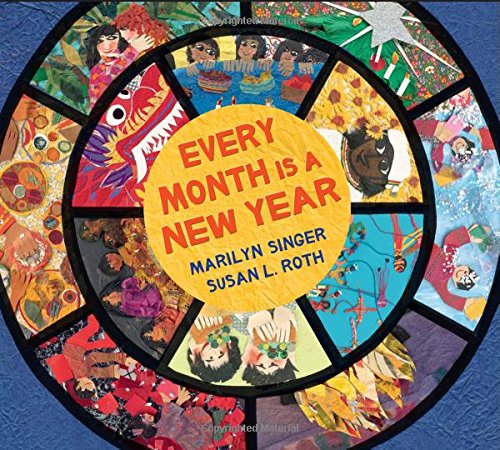
The picture book is arranged like a monthly calendar; when turned to the side, the left page serves as the image seen at the top of the calendar, created with mixed media illustrations to show readers a glimpse of the celebrations described. The right side of the page hosts the poem on a background that looks like the squares that represent the days of the month. Roth's illustrations add to the childlike wonder of the book, with the illustrations made of cut out materials such as tissue paper, textured paper, and patterned craft paper, layered on top of one another to create depth. Each calendar page is unique to the holidays. For example, confetti is sprinkled on the page for the Midnight Ball Drop in New York City. Even the calendar squares are beautiful and unique, layered with gorgeous patterned papers. Little details are in each piece, such as the kite strings for the celebration of Matariki, which are made of actual string.

Some people might have an emotional connection to the book if they have a special memory or connection to a holiday or celebration mentioned. Otherwise, the book is more informational, lacking the evocative emotion seen often in poetry. While the book is meant to educate and add to children's multicultural literacy, it could easily be incorporated into the curriculum and special interest learning sessions for people of all ages. As mentioned by Dr. Vardell, poetry can be enjoyed at any age (2019, p. 133), and that picture books are beneficial for older children, as well (2019, p. 74).


AWARDS
2019 NCTE Notable Poetry Books list

REVIEW EXCERPTS
"The collage illustrations, using paper sourced from across the globe, are spectacular, with culturally distinctive elements yet a consistent style, and the back matter is stellar and solid, with additional information, pronunciations, a map, and thorough source notes. This complete package is an illuminating and respectful appreciation of both our global uniqueness and our commonality." - Booklist, starred review

"A visually and sonically stunning introduction to the importance of appreciating time and the change of seasons throughout the world: a multicultural gem." - Kirkus Reviews, starred review

"[A] lovely collection that both looks back at tradition and forward to new beginnings, wherever one might live." - Publishers Weekly, starred review

"A complex and rewarding package that will be cherished by children and adults alike. A strong choice for poetry collections." - School Library Journal


CONNECTIONS
Enrichment activities: The back matter of the book is full of additional information and a list of the author's sources, which can help teachers and librarians create lessons on celebrations in other countries and cultures. The publisher has even provided a teacher's guide, available on their website (Lee & Low Books, 2018).

Related books:
DK. (2016). Children just like me: A new celebration of children around the world. DK Children.
ISBN: 978-1465453921


Halford, K. (2019). Celebrations around the world: The fabulous celebrations you won't want to miss. DK Children.
ISBN: 978-1465483904


Lamothe, M. (2017). This is how we do it: One day in the lives of seven kids from around the world. Chronicle Books.
ISBN: 978-1452150185

Stewart, W., & Engel, C. (2019). What do you celebrate? Holidays and festivals around the world. Sterling Children's Books.
ISBN: 978-1454932130


REFERENCES
Lee & Low Books. (2018). Every month is a new year teacher's guide [PDF]. Lee & Low Books. https://www.leeandlow.com/uploads/loaded_document/571/EVERYMONTHISANEWYEAR_TeachersGuide.pdf


Singer, M., & Roth, S. L. (2018). Every month is a new year. Lee & Low Books.

Vardell, S. M. (2019). Children's literature in action: A librarian's guide (3rd edition). Libraries Unlimited.

Book Review: Brown Girl Dreaming by Jacqueline Woodson


BIBLIOGRAPHY
Title: Brown Girl Dreaming
Author: Jacqueline Woodson
Publisher: Nancy Paulson Books
Publication Date: August 28, 2014
ISBN: 978-0399252518


PLOT SUMMARY
Award-winning author Jacqueline Woodson's free-verse memoir draws readers into her childhood growing up in the 1960s and 1970s. While the novel takes place during the civil rights movement, the story focuses on Woodson and her family. Woodson describes the displacement she experienced in her childhood, starting when her mother left her father. Woodson and her siblings moved from Ohio to their grandparents' home in South Carolina and were teased by other children for their northern way of talking. Her grandmother raised them as Jehovah's Witnesses when Woodson's mother leaves the children for an extended period to find a new home. Her life was upended again when her mother, pregnant with a child whose father is never named or mentioned, moved the family to Brooklyn, New York. There, they experienced isolation from other children who did not understand their religion's rules. Despite these upheavals, the story often portrays the joys of Woodson's childhood and the deep love between her family, as well as Woodson's growth from a struggling reader to a professional author through her passion for storytelling.


CRITICAL ANALYSIS
Brown Girl Dreaming is a memoir smartly told as a free-verse novel, perfectly capturing the way adults recall childhood memories; fragments in time, often seemingly mundane, but for some unexplainable reason impactful to our minds. What may seem like an inconsequential memory is vividly recalled through rich imagery, creating crystal clear images in readers' minds. "Saturday night smells of biscuits and burning hair. / Supper done and my grandmother has transformed / the kitchen into a beauty shop. Laid across the table / is the hot comb, Dixie Peach hair grease / horsehair brush, parting stick / and one girl at a time." (Woodson, 2014, p. 83).

Consonance is also often used to add to the sound of the rhythm. In the poem "The Ghosts of the Nelsonville House", 'c's and k's create and quick and slick lines that roll off the tongue."Once, there were so many children here / running through this house / up and down the stairs, hiding under beds / and in trunks, / sneaking into the kitchen for tiny pieces / of icebox cake, cold fried chicken, thick slices of their mother's honey ham..." (Woodson, 2014, p. 11).

Woodson cleverly breaks down her story into short poetic lines, deliberately placing words individually onto lines to create a staccato rhythm. This starts immediately on the first page: "I am born on a Tuesday at University Hospital / Columbus, Ohio / USA— / a country caught / between Black and White." (Woodson, 2014, p. 1).

Even the use of italics provides opportunities to switch from speaking softly to loudly when reading aloud. "I do not know if I'll be strong like Ruby. / I do not know what the world will look like / when I am finally able to walk, speak, write... / Another Buckeye! / the nurse says to my mother." (Woodson, 2014, p. 4).

Brown Girl Dreaming is a story about Woodson's childhood and is wrought with emotion, specifically the familial love of the Woodsons. It is difficult to choose a poem that exemplifies this theme, as there are so many. However, the three back-to-back poems regarding the bus to Greenville were particularly striking - "Each Winter," "Journey," and "Greenville, South Carolina, 1963." Woodson's father's angry speech that his children will never sit at the back of the bus is juxtaposed in the next poem as her mother quietly whispers to her children they are worthy and not lesser than those who sit at the front (Woodson, 2014, p. 29-31).

The book is organized mostly chronologically, starting with Woodson's birth, with some poems taking place before Woodson's birth, such as when her mother's brother passed away. At the beginning of the book is a family tree to help readers keep track of the many family members mentioned in the book. At the end are childhood photos of Woodson's family, including the wedding photo that Woodson specifically mentions is the only photo of her parents in the poem "Leaving Columbus" (Woodson, 2014, p. 40).


This is a book that can be enjoyed by anyone, and Woodson's struggle with reading should be especially relatable to other children who experience the same. Woodson's growth as an award-winning author should be especially hopeful to reluctant readers out there who may feel they will never enjoy the written word.

AWARDS
2015 Coretta Scott King Award for Author
2015 Newbery Medal Honor Book
2015 Sibert Medal Honor Book
2015 ALSC Notable Children's Books List
2015 NAACP Image Award for Outstanding Literary Work In YA Fiction
2014 National Book Award for Young People's Literature


REVIEW EXCERPTS
"The resulting memoir in verse is a marvel... the result is both elegant and eloquent, a haunting book about memory that is itself altogether memorable." - Booklist, starred review

"An extraordinary—indeed brilliant—portrait of a writer as a young girl." - The Horn Book, starred review

"Woodson cherishes her memories and shares them with a graceful lyricism; her lovingly wrought vignettes of country and city streets will linger long after the page is turned." -Kirkus Reviews, starred review

"The writer’s passion for stories and storytelling permeates the memoir, explicitly addressed in her early attempts to write books and implicitly conveyed through her sharp images and poignant observations seen through the eyes of a child." - Publishers Weekly, starred review

"With exquisite metaphorical verse Woodson weaves a patchwork of her life experience, from her supportive, loving maternal grandparents, her mother's insistence on good grammar, to the lifetime friend she meets in New York, that covers readers with a warmth and sensitivity no child should miss. This should be on every library shelf." - School Library Journal, starred review


CONNECTIONS
Enrichment activities: The book has several references to historical figures that can be used to connect to topics regarding the civil rights movement. One poem in the book, "Greenville, South Carolina, 1963," specifically addresses Woodson's mother's fear as she takes her children to the back of the bus to South Carolina. The book can even be linked to learning about black troops in the Civil War, as Woodson mentions in the poems "It'll be Scary Sometimes" that her paternal great-great-grandfather was born free and was part of the United States Colored Troops.

Related books:
Lai, T. (2011). Inside out and back again. HarperCollins.
ISBN: 978-0061962783

Nelson, M. (2016). How I discovered poetry. Speak.
ISBN: 978-0147510051

Weatherford, C.B., & Cooper, F. (2008). Becoming Billie Holiday. WordSong.
ISBN: 978-1590785072

Woodson, J. (2007). Feathers. G.P. Putnam's Sons Books for Young Readers.
ISBN: 978-0399239892

Woodson, J. (2003). Locomotion. Nancy Paulson Books.
ISBN: 978-0399231155

REFERENCES
Woodson, J. (2014). Brown Girl Dreaming. Nancy Paulson Books

Book Review: El Deafo by Cece Bell

BIBLIOGRAPHY Title : El Deafo Author : Cece Bell Illustrators : Cece Bell and David Lasky Publisher : Amulet Books Publication Date : ...