Monday, March 2, 2020

Book Review: The Poet X by Elizabeth Acevedo

Image result for the poet x cover
BIBLIOGRAPHY
Title: The Poet X
Author: Elizabeth Acevedo

Publisher: Quill Tree Books
Publication Date: March 6, 2018
ISBN
978-0062662804

PLOT SUMMARY
Elizabeth Acevedo's multi-award-winning novel debut chronicles the coming-of-age story of teenager Xiomara Batista, told in verse from Xiomara's point-of-view. The twin daughter in a Dominican Catholic family, Xiomara uses her poetry to channel the turbulent emotions she feels: the helplessness of feeling unheard by her strict religious mother, the anger she feels at her body development and the classmates who ogle her, her frustration and confusion with her sexuality, her religious doubts. Xiomara is lost in her self-identity, caught between the daughter she is expected to be, the fighter she believes she has no choice to be, and the person she slowly wants to be when her teacher continuously invites her to her school's slam poetry club. Bottling up the secrets and feelings she keeps from everyone inside, her poetry is her only escape.


CRITICAL ANALYSIS
I began weeping when I reached the end of the poem "The Ugly," (Acevedo, 2018, p. 301), tears streaming down my face by the end of the following poem "Let Me Explain" (Acevedo, 2018, p. 303).

At the risk of breaking the objective tone of this review, it would be a disservice to this book if I did not describe the emotional experience I had reading it. Xiomara is far from relatable to me—she is Dominican, raised by poor immigrants in Harlem. I am a white, middle-class woman in the South with more privileges given to me than most people I know. Yet, Acevedo's verses are so immersive, I could feel myself in Xiomara's head.

This impactful free-verse novel is entirely deserving of the praise it has received. Every line and word felt deliberate and perfectly placed, matching Xiomara's emotions and state-of-mind. The placement alone feels like an art, adding a visual that builds the emotions. In "Let Me Explain," the lines, "That I'm sorry. / That I'm sorry. / That I'm sorry" (Acevedo. p. 302) are staggered and read like Xiomara is tripping over the threshold in a rush to rescue her most precious possession. In "Verses," (Acevedo, 2018, p. 306-307) Xiomara roars impromptu spoken-word poetry on the left side of the page, while her mother recites a prayer in Spanish on the right side of the page, creating the visual of them standing across the room from each other. In "Ants," each word stretches across the page, mirroring the text that describes Xiomara's mother dragging her to the altar of the Virgin (Acevedo, 2018, p. 198-201). In the following poem, "I Am No Ant," (Acevedo, 2018, p. 202-203), each line is one word, as though Xiomara is angrily biting out each word.

There is no doubt that I could go on and on, dissecting each and every poem for the mastery of its craft.

The content of the book is entirely relatable for teenagers and reads like a teenager. I confess there were moments that I was scared for Xiomara, worried she would have her heartbroken and used by a boy, just like I did at her age. However, I could also understand the choices she made, as it was not so long ago that I was a teenager and had the same thoughts. I had to chuckle at Xiomara's sanitized homework assignments juxtaposed against what she actually wanted to write. There were often times I thought the same, how I would prefer to write something real, but instead turned in the type of assignment I knew my teachers expected.

The use of Spanish was also refreshing and is likely to appeal to Spanish-speaking readers, especially if any are reluctant English readers.


AWARDS
Carnegie Medal, 2019
Pura Belpré Award, 2019
Golden Kite Award for Young Adult Fiction, 2019
Michael L. Printz Award for Excellence in Young Literature, 2019
Odyssey Award Honor Audiobook, 2019
Amelia Bloomer List, 2019
YALSA's Best Fiction for Young Adults, 2019
ALSC's Notable Children's Books, 2019
National Book Award for Young People's Literature, 2018

REVIEW EXCERPTS
"Spoken-word artist Acevedo’s debut verse novel is an arresting portrait of a young poet coming into her own. In nearly every poem, there is at least one universal truth about adolescence, family, gender, race, religion, or sexuality that will have readers either nodding in grateful acknowledgment or blinking away tears." - The Horn Book, starred review

"Poignant and real, beautiful and intense, this story of a girl struggling to define herself is as powerful as Xiomara’s name: “one who is ready for war.” - Kirkus Reviews, starred review

"Debut novelist Acevedo’s free verse gives Xiomara’s coming-of-age story an undeniable pull, its emotionally charged bluntness reflecting her determination and strength." - Publishers Weekly, starred review

"Truly a “lantern glowing in the dark” for aspiring poets everywhere. All YA collections will want to share and treasure this profoundly moving work." - School Library Journal, starred review

"Ultimately, though, this is a powerful, heartwarming tale of a girl not afraid to reach out and figure out her place in the world." - Booklist

CONNECTIONS
Enrichment activities: This novel is perfect for introducing teens to spoken word poetry. This novel could be connected to a teen poetry slam at a public library or used to supplement a curriculum about poetry in schools.


Related books:
Acevedo, E. (2020). Write yourself a lantern: A journal inspired by The Poet X. HarperCollins.
ISBN: 978-0062982278

Acevedo, E. (2019). We set the fire on high. Quill Tree Books.
ISBN: 978-0062662835

Grimes, N. (2001). Bronx masquerade. Dial.
ISBN: 978-0803725690

Sanchez, E. L. (2017). I am not your perfect Mexican daughter. Knopf Books for Young Readers.
ISBN: 978-1524700485

Tamani, L. (2017). Calling my name. Greenwillow Books.
ISBN: 978-0062656865

Watson, R. (2018). Piecing me together. Bloomsbury YA.
ISBN: 978-1681191072

Wong, J. L. (2005). Seeing Emily. Harry N. Abrams.
ISBN: 978-0810957572

REFERENCES
Acevedo, E. (2018). The poet X. Quill Tree Books.

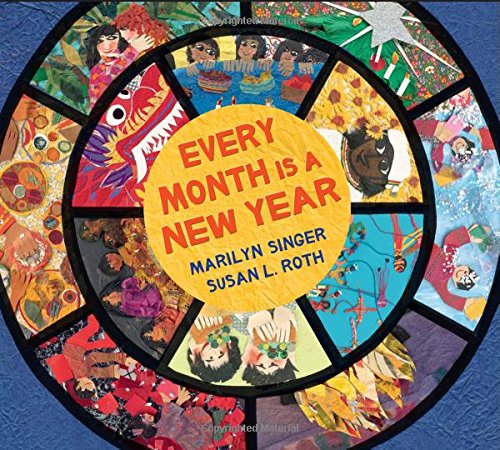
Book Review: Every Month is a New Year by Marilyn Singer and Susan L. Roth

Image result for every month is a new year
BIBLIOGRAPHY
Title: Every Month is a New Year
Author: Marilyn Singer
Illustrator: Susan L. Roth
Publisher: Lee & Low Books
Publication Date: May 15, 2018
ISBN: 978-1620141625


PLOT SUMMARY
This topical collection of poems is centered around showcasing how the New Year is celebrated in different countries and cultures, many of which take place in different months of the year. The celebrations include the Midnight Ball Drop in New York City, Hogmanay in Scotland, Russian New Years, Chinese New Year, Nowruz in Iran, Songkran in Thailand, Islamic New Year on the First Day of Muharram, the Māori celebration of Matariki in New Zealand, the Mapuche celebration of We Tripantu in Chile and Argentina, the Egyptian celebration of Wep Ronpet, the Persian New Year on Navroze, Diwali in India, the Ethiopian New Year on Enkutatash, the Jewish celebration of Rosh Hashanah, Año Viejo in Ecuador, and Nochevieja in Spain. This collection includes an introduction explaining when these celebrations take place, and how some celebrations are secular, some religious, and some are a mixture of the two. The back of the book includes a hefty amount of information, including calendars, new year's greetings, information about the celebrations, a glossary and pronunciation guide, and a full list of the author's sources.

CRITICAL ANALYSIS
This topical collection of poems by poet Marilyn Singer is illustrated in a picture book format by artist Susan L. Roth. The book is arranged chronologically, starting with New Year's celebrations that begin at midnight on January 1, wrapping through the year to the following December 31.

Most of the poems are a rhyming rhythm, but how much rhyming is used varies from poem to poem. Some are short, with short phrases and single words on a line to create a staccato rhythm. For example, in the poem "Midnight Ball Drop," which has an internal rhyme, "Tonight, / hand in hand with Grandma, I stand in the / middle of this merry, loud crowd / waiting / for that glittering ball / to drop at the magic / hour, bringing on a confetti / shower." (Singer & Roth, 2018, "Midnight Ball Drop"). Other poems are musical rhyming couplets, with every line matching sounds at the end or at the end of every other line, such as "Midnight! And the bells are ringing! / "Auld Lang Syne"—they're downstairs, singing!" (Singer & Roth, 2018, "First Footing"). Other poems do not rhyme at all, though, such as the poem "New Moon, New Year." The last poem in the book is a mirror version of the first, the lines reading in a backward order of the first poem.

When reading the book with the illustrations covered, though, it was difficult to imagine the celebrations without reading the background information supplied at the end of the book. Roth's illustrations are so detailed and beautiful, it may affect the impact of the poems if they are separated from the visual art.

The picture book is arranged like a monthly calendar; when turned to the side, the left page serves as the image seen at the top of the calendar, created with mixed media illustrations to show readers a glimpse of the celebrations described. The right side of the page hosts the poem on a background that looks like the squares that represent the days of the month. Roth's illustrations add to the childlike wonder of the book, with the illustrations made of cut out materials such as tissue paper, textured paper, and patterned craft paper, layered on top of one another to create depth. Each calendar page is unique to the holidays. For example, confetti is sprinkled on the page for the Midnight Ball Drop in New York City. Even the calendar squares are beautiful and unique, layered with gorgeous patterned papers. Little details are in each piece, such as the kite strings for the celebration of Matariki, which are made of actual string.

Some people might have an emotional connection to the book if they have a special memory or connection to a holiday or celebration mentioned. Otherwise, the book is more informational, lacking the evocative emotion seen often in poetry. While the book is meant to educate and add to children's multicultural literacy, it could easily be incorporated into the curriculum and special interest learning sessions for people of all ages. As mentioned by Dr. Vardell, poetry can be enjoyed at any age (2019, p. 133), and that picture books are beneficial for older children, as well (2019, p. 74).


AWARDS
2019 NCTE Notable Poetry Books list

REVIEW EXCERPTS
"The collage illustrations, using paper sourced from across the globe, are spectacular, with culturally distinctive elements yet a consistent style, and the back matter is stellar and solid, with additional information, pronunciations, a map, and thorough source notes. This complete package is an illuminating and respectful appreciation of both our global uniqueness and our commonality." - Booklist, starred review

"A visually and sonically stunning introduction to the importance of appreciating time and the change of seasons throughout the world: a multicultural gem." - Kirkus Reviews, starred review

"[A] lovely collection that both looks back at tradition and forward to new beginnings, wherever one might live." - Publishers Weekly, starred review

"A complex and rewarding package that will be cherished by children and adults alike. A strong choice for poetry collections." - School Library Journal


CONNECTIONS
Enrichment activities: The back matter of the book is full of additional information and a list of the author's sources, which can help teachers and librarians create lessons on celebrations in other countries and cultures. The publisher has even provided a teacher's guide, available on their website (Lee & Low Books, 2018).

Related books:
DK. (2016). Children just like me: A new celebration of children around the world. DK Children.
ISBN: 978-1465453921


Halford, K. (2019). Celebrations around the world: The fabulous celebrations you won't want to miss. DK Children.
ISBN: 978-1465483904


Lamothe, M. (2017). This is how we do it: One day in the lives of seven kids from around the world. Chronicle Books.
ISBN: 978-1452150185

Stewart, W., & Engel, C. (2019). What do you celebrate? Holidays and festivals around the world. Sterling Children's Books.
ISBN: 978-1454932130


REFERENCES
Lee & Low Books. (2018). Every month is a new year teacher's guide [PDF]. Lee & Low Books. https://www.leeandlow.com/uploads/loaded_document/571/EVERYMONTHISANEWYEAR_TeachersGuide.pdf


Singer, M., & Roth, S. L. (2018). Every month is a new year. Lee & Low Books.

Vardell, S. M. (2019). Children's literature in action: A librarian's guide (3rd edition). Libraries Unlimited.

Book Review: Brown Girl Dreaming by Jacqueline Woodson


BIBLIOGRAPHY
Title: Brown Girl Dreaming
Author: Jacqueline Woodson
Publisher: Nancy Paulson Books
Publication Date: August 28, 2014
ISBN: 978-0399252518


PLOT SUMMARY
Award-winning author Jacqueline Woodson's free-verse memoir draws readers into her childhood growing up in the 1960s and 1970s. While the novel takes place during the civil rights movement, the story focuses on Woodson and her family. Woodson describes the displacement she experienced in her childhood, starting when her mother left her father. Woodson and her siblings moved from Ohio to their grandparents' home in South Carolina and were teased by other children for their northern way of talking. Her grandmother raised them as Jehovah's Witnesses when Woodson's mother leaves the children for an extended period to find a new home. Her life was upended again when her mother, pregnant with a child whose father is never named or mentioned, moved the family to Brooklyn, New York. There, they experienced isolation from other children who did not understand their religion's rules. Despite these upheavals, the story often portrays the joys of Woodson's childhood and the deep love between her family, as well as Woodson's growth from a struggling reader to a professional author through her passion for storytelling.


CRITICAL ANALYSIS
Brown Girl Dreaming is a memoir smartly told as a free-verse novel, perfectly capturing the way adults recall childhood memories; fragments in time, often seemingly mundane, but for some unexplainable reason impactful to our minds. What may seem like an inconsequential memory is vividly recalled through rich imagery, creating crystal clear images in readers' minds. "Saturday night smells of biscuits and burning hair. / Supper done and my grandmother has transformed / the kitchen into a beauty shop. Laid across the table / is the hot comb, Dixie Peach hair grease / horsehair brush, parting stick / and one girl at a time." (Woodson, 2014, p. 83).

Consonance is also often used to add to the sound of the rhythm. In the poem "The Ghosts of the Nelsonville House", 'c's and k's create and quick and slick lines that roll off the tongue."Once, there were so many children here / running through this house / up and down the stairs, hiding under beds / and in trunks, / sneaking into the kitchen for tiny pieces / of icebox cake, cold fried chicken, thick slices of their mother's honey ham..." (Woodson, 2014, p. 11).

Woodson cleverly breaks down her story into short poetic lines, deliberately placing words individually onto lines to create a staccato rhythm. This starts immediately on the first page: "I am born on a Tuesday at University Hospital / Columbus, Ohio / USA— / a country caught / between Black and White." (Woodson, 2014, p. 1).

Even the use of italics provides opportunities to switch from speaking softly to loudly when reading aloud. "I do not know if I'll be strong like Ruby. / I do not know what the world will look like / when I am finally able to walk, speak, write... / Another Buckeye! / the nurse says to my mother." (Woodson, 2014, p. 4).

Brown Girl Dreaming is a story about Woodson's childhood and is wrought with emotion, specifically the familial love of the Woodsons. It is difficult to choose a poem that exemplifies this theme, as there are so many. However, the three back-to-back poems regarding the bus to Greenville were particularly striking - "Each Winter," "Journey," and "Greenville, South Carolina, 1963." Woodson's father's angry speech that his children will never sit at the back of the bus is juxtaposed in the next poem as her mother quietly whispers to her children they are worthy and not lesser than those who sit at the front (Woodson, 2014, p. 29-31).

The book is organized mostly chronologically, starting with Woodson's birth, with some poems taking place before Woodson's birth, such as when her mother's brother passed away. At the beginning of the book is a family tree to help readers keep track of the many family members mentioned in the book. At the end are childhood photos of Woodson's family, including the wedding photo that Woodson specifically mentions is the only photo of her parents in the poem "Leaving Columbus" (Woodson, 2014, p. 40).


This is a book that can be enjoyed by anyone, and Woodson's struggle with reading should be especially relatable to other children who experience the same. Woodson's growth as an award-winning author should be especially hopeful to reluctant readers out there who may feel they will never enjoy the written word.

AWARDS
2015 Coretta Scott King Award for Author
2015 Newbery Medal Honor Book
2015 Sibert Medal Honor Book
2015 ALSC Notable Children's Books List
2015 NAACP Image Award for Outstanding Literary Work In YA Fiction
2014 National Book Award for Young People's Literature


REVIEW EXCERPTS
"The resulting memoir in verse is a marvel... the result is both elegant and eloquent, a haunting book about memory that is itself altogether memorable." - Booklist, starred review

"An extraordinary—indeed brilliant—portrait of a writer as a young girl." - The Horn Book, starred review

"Woodson cherishes her memories and shares them with a graceful lyricism; her lovingly wrought vignettes of country and city streets will linger long after the page is turned." -Kirkus Reviews, starred review

"The writer’s passion for stories and storytelling permeates the memoir, explicitly addressed in her early attempts to write books and implicitly conveyed through her sharp images and poignant observations seen through the eyes of a child." - Publishers Weekly, starred review

"With exquisite metaphorical verse Woodson weaves a patchwork of her life experience, from her supportive, loving maternal grandparents, her mother's insistence on good grammar, to the lifetime friend she meets in New York, that covers readers with a warmth and sensitivity no child should miss. This should be on every library shelf." - School Library Journal, starred review


CONNECTIONS
Enrichment activities: The book has several references to historical figures that can be used to connect to topics regarding the civil rights movement. One poem in the book, "Greenville, South Carolina, 1963," specifically addresses Woodson's mother's fear as she takes her children to the back of the bus to South Carolina. The book can even be linked to learning about black troops in the Civil War, as Woodson mentions in the poems "It'll be Scary Sometimes" that her paternal great-great-grandfather was born free and was part of the United States Colored Troops.

Related books:
Lai, T. (2011). Inside out and back again. HarperCollins.
ISBN: 978-0061962783

Nelson, M. (2016). How I discovered poetry. Speak.
ISBN: 978-0147510051

Weatherford, C.B., & Cooper, F. (2008). Becoming Billie Holiday. WordSong.
ISBN: 978-1590785072

Woodson, J. (2007). Feathers. G.P. Putnam's Sons Books for Young Readers.
ISBN: 978-0399239892

Woodson, J. (2003). Locomotion. Nancy Paulson Books.
ISBN: 978-0399231155

REFERENCES
Woodson, J. (2014). Brown Girl Dreaming. Nancy Paulson Books

Sunday, February 16, 2020

Book Review: Rumpelstiltskin, retold and illustrated by Paul O. Zelinsky

Image result for rumpelstiltskin paul o zelinsky cover
BIBLIOGRAPHY
Title: Rumpelstiltskin
Retold and illustrated by: Paul O. Zelinsky
Publisher: Dutton Children's Books
Publication Date: October 16, 1986
ISBN: 978-0525442653


PLOT SUMMARY
In this version of the traditional tale, a poor miller lies to the king that his daughter can spin straw into gold. The greedy king locks her in a room and orders her to spend the night spinning straw into gold. If she fails, she will be executed. As she weeps, the girl is approached by a tiny man, who will spin the straw into gold if the girl gives him her necklace. The second night, the girl offers her ring to the tiny man to spin the straw into gold. On the third night, the king says he will marry the girl if she completes her tasks again. Not having anything else to offer, she agrees to give her future firstborn to the tiny man, A year later, the girl, who is now the queen, begs to keep her child, and the tiny man says he will only let her do so if she can guess his name within three days. The queen sends her most faithful servant to follow the man into the woods, discovering that his name is Rumpelstiltskin. The queen correctly states the Rumpelstiltskin's names, and in a fury, he jumps on his cooking spoon and flies out the window.

The back of the book includes the history of Rumpelstiltskin and the differences between the major editions of the story. Zelinsky explains that his version of the tale combines text and dialogue from various versions, as well as new elements that he deemed best suitable for a picture book.


CRITICAL ANALYSIS
The miller's daughter, who is nameless like all the other characters in the story, is an archetype of good. There is a gray area with both Rumpelstiltskin and the king, though. While Rumpelstiltskin is the villain of the story, since he threatens to take the queen's child, he did serve as the daughter's savior. The king is not good, either; he is greedy and threatens to execute the girl if she cannot spin straw into gold, even though it was her father who lied to the king.

The plot follows a simple formula, where for three nights the girl makes a deal with Rumpelstiltskin to spin the straw into gold. The third night diverges when she has no material possessions to offer and agrees to give her future firstborn child to Rumpelstiltskin. The story also follows the typical themes of traditional tales, where good triumphs over evil, and the queen and her baby live happily ever after.

Zelinsky's illustrations are works of art. His illustrations reflect the style of oil painting in the late Renaissance, similar to artists like Giorgione and Titian (History.com, 2019). Zelinsky even incorporates the Reinassance oil painting technique of applying oil glazes over black and white tempera paint (Zelinsky, n.d.). The art is purely European, but what area of Europe is not immediately discernible to those who are not experts on the subject.

The lush art does not overwhelm the story, though. At first impression, this book may seem too sophisticated for children, but such is not the case. Zelinsky seamlessly uses dialogue that works perfectly for reading aloud for children: "He pulled three times-whir! whir! whir!—and the spool was wound full of gold thread. He fitted another spool on, and—whir! whir! whir! whir!—three pulls and that one too was full." The almost cartoonish design of Rumpelstiltskin will make children giggle, especially the demented and hilarious illustration of him riding on a cooking spoon and singing. This is another moment perfect for reading aloud to children.


AWARDS
1987 Caldecott Medal Honor Book


REVIEW EXCERPTS
"One of the most exquisite picture books of the season, Zelinsky's Rumpelstiltskin will have strong appeal for children and for adult picture-book collectors alike." - Publishers Weekly

"Zelinsky's smooth retelling and glowing pictures cast the story in a new and beautiful light." - School Library Journal

"A distinguished edition of one of Grimm's favorite tales." - Kirkus Reviews


CONNECTIONS
Enrichment activities: There are a plethora of gorgeously illustrated picture book versions of traditional tales for children. In the list below are several of those books. Take the opportunity to introduce children to art concepts, and lessons on famous artists from major artistic movements, such as the Renaissance.


Related books:
Lesser, R., & Zelinsky, P.O. (1999). Hansel and Gretel. New York, NY: Dutton Children's Books.
ISBN: 978-0525461524

Zelinsky, P. O. (1997). Rapunzel. New York, NY: Dutton Children's Books.
ISBN: 978-0525456070

Craft, M.F., & Craft, K.Y. (2016). Beauty and the Beast. New York, NY: HarperCollins.
ISBN: 978-0060539191

Craft, C., & Craft, K.Y. (2003). King Midas and the Golden Touch. New York, NY: HarperCollins.
ISBN: 978-0060540630

Craft, M. F., & Craft, K.Y. (2002). Sleeping Beauty. San Francisco, CA: Chronicle Books.
ISBN: 978-1587171208

Craft, M.F., & Craft, K.Y. (2000). Cinderella. San Francisco, CA: Chronicle Books.
ISBN: 978-1587170041

Mayer, M., & Craft, K.Y. (1989). The Twelve Dancing Princesses. New York, NY: HarperCollins.
ISBN: 978-0688080518


REFERENCES
History.com. (2019, September 20). Renaissance art. Retrieved from https://www.history.com/topics/renaissance/renaissance-art

Zelinsky, P.O. (n.d.). Rumpelstiltskin. Retrieved from http://www.paulozelinsky.com/rumpelstiltskin.html

Book Review: The Three Little Wolves and the Big Bad Pig by Eugene Trivizas and Helen Oxenbury

Image result for the three little wolves and the big bad pig
BIBLIOGRAPHY
Title: The Three Little Wolves and the Big Bad Pig
Author: Eugene Trivizas
Illustrator: Helen Oxenbury
Publisher: Margaret K. McElderry Books
Publication Date: September 30, 1993
ISBN978-0689505690

PLOT SUMMARY
In this inverted version of the fable The Three Little Pigs, three little wolves are pursued by the Big Bad Pig. With the help of various animal friends, the wolves build a house out of brick, a house out of concrete, and a house out of barbed wire, iron bars, and armor plates. Each house is destroyed by the Big Bad Pig, who cannot huff and puff these houses down, so instead resorts to a sledgehammer, a pneumatic drill, and even dynamite. The three little wolves decide that their building materials must be the problem, and build themselves a beautiful house of flowers. When the Big Bad Pig huffs and puffs the flowers, the fragrant scent softens his heart and he realizes the error of his ways. The three little wolves invite the Big Bad Pig to play and live with them.

CRITICAL ANALYSIS
Like the traditional fable, the characters of The Three Little Wolves and the Big Bad Pig represent the archetypes of good and evil. A major change in the story is the lack of violence, which delineates the difference between good and evil more in this version. In the traditional version, the two of the pigs are devoured by the wolf. The third pig in the house of brick boils the wolf alive and then cooks and eats him. The only harm to the wolves in this version is that their "fluffy tails are scorched." Rather than tricking the pig by violent means, they find a peaceful way to stop his destruction and even form a lifelong friendship.

Oxenbury's illustration adds to these archetypes, drawing the wolves as adorable. These character designs supplemented by the description "three cuddly little wolves with soft fur and fluffy tails." Meanwhile, the Big Bad Pig is illustrated as a menacing villain, grimacing throughout the book.

The plot follows the formula of the traditional tale, but with the stakes increased. Rather than a house made of straw and a house of sticks, the story uses building materials that may be more familiar to children - bricks, concrete, and metal. Since these materials are so sturdy, the Big Bad Pig humorously is not able to huff and puff these houses down and instead destroys the houses in wild spectacles.

The story and illustrations are humorous from the first page, starting with the illustration of the mother wolf in bed wearing curlers in her hair. Children will be tickled by the wolves playing human games including croquet and battledore and shuttlecock. Even the cover is humorous, showing the three little wolves sitting on a scaffold eating lunch like construction workers. Oxenbury deftly handles color and their illustration medium to create exciting pages, including a two-page spread of an explosion, while also creating beautiful and soft moments, such as the wolves building their house made of flowers.

AWARDS
1994 ALSC Notable Children's Books

REVIEW EXCERPTS
"In his English-language debut, Trivizas laces the text with funny, clever touches, from an ensemble of animals who obligingly donate whatever building materials the wolves require, to the wolves' penultimate, armor-plated residence replete with a "video entrance phone" over which the pig can relay his formulaic threats. Oxenbury's watercolors capture the story's broad humor and add a wealth of supplementary details, with exquisite renderings of the wolves' comic temerity and the pig's bellicose stances. Among the wittiest fractured fairytales around." - Publishers Weekly

"Oxenbury's pastel watercolor illustrations combine the coziness of a nursery tale with tongue-in-cheek humor. They are animated and full of personality. Children familiar with The Three Little Pigs will enjoy the turnabout, the narrow escapes, and the harmonious ending. This may also be used to inspire them to develop their own adaptations of classic tales." - School Library Journal

"Never mind the other incarnations of this tale--classic, fractured, rapped; this inversion will have children giggling from the outset." - Kirkus Reviews

CONNECTIONS
Enrichment activities: There are several variants of The Three Little Pigs. Teachers and librarians can engage children in studying this fable and comparing and contrasting variants.

Related books:
Scieszka, J., & Smith, L. (1989). The True Story of the 3 Little Pigs! New York, NY: Viking Kestrel Picture Books.
ISBN: 978-0670827596

Teague, M. (2018). The Three Little Pigs and the Somewhat Bad Wolf. New York, NY: Cartwheel Books.
ISBN: 978-1338157741

Gunderson, J., & Bernardini, C. L. (2016). No Lie, Pigs (and Their Houses) Can Fly!: The Story of the Three Little Pigs as Told by the Wolf. North Mankato, MN: Picture Window Books.
ISBN: 978-1479586257

Schwartz, C. R., & Santat, D. (2012). The Three Ninja Pigs. New York, NY: G.P. Putnam's Sons Books for Young Readers.
ISBN: 978-0399255144

Disney, R. H. (2004). The Three Little Pigs. New York, NY: Golden/Disney.
ISBN: 978-0736423120

Wiesner, D. (2001). The Three Pigs. Boston, MA: Clarion Books.
ISBN: 978-0618007011

Marshall, J. (2000). The Three Little Pigs. New York, NY: Grosset & Dunlap.
ISBN: 978-0448422886

Lowell, S., & Harris, J. (1992). The Three Little Javelinas. Lanham, MD: Cooper Square Publishing.
ISBN: 978-0873585422

Book Review: Just A Minute: A Trickster Tale and Counting Book by Yuyi Morales

Image result for just a minute yuyi morales cover
BIBLIOGRAPHY
Title: Just A Minute: A Trickster Tale and Counting Book
Author and Illustrator: Yuyi Morales
Publisher: Chronicle Books
Publication Date: September 1, 2003
ISBN: 978-0811837583


PLOT SUMMARY
Grandma Beetle is visited by Señor Calavera, a living and speaking skeleton man. He tells Grandma Beetle that "it is time for her to come along with him," but Grandma Beetle continuously delays her departure by requesting that Señor Calavera let her finish household chores. She counts her chores in English and Spanish, gradually exasperating Señor Calavera with her numerous chores, to the point where he joins in to help her finish her chores faster. Finally, it is revealed that Grandma Beetle has been preparing to celebrate her birthday with her nine beautiful grandchildren, and invites Señor Calavera to share their meal. After hugging and kissing her grandchildren goodbye, she is ready to leave, only to find that Señor Calavera had so much fun at the birthday party and looks forward to attending her next one.


CRITICAL ANALYSIS
Just A Minute: A Trickster Tale and Counting Book is an original trickster folktale that is steeped in Mexican culture, from the various storytelling devices to the art of the picture book.


Grandma Beetle is the eponymous trickster of the story, who uses her wiles to trick the patient Señor Calavera into delaying her departure. The name for "Señor Calavera" has many meanings. The word "calavera" means "skull," and is often referred to the brightly colorful sugar skulls used in Día de los Muertos celebrations. The word was also used in the late 18th century and early 19th century to describe short, humorous poems, which were often sarcastic tombstone epitaphs (Ward, 2017). This short and humorous picture book nods to the literary calaveras of Día de los Muertos.

As a counting book, each page has a predictable pattern. Using numbers in English and Spanish, Grandma Beetle stresses that she has another chore to complete: "uno house to sweep," "dos pots of tea to boil," "tres pounds of corn to make into tortillas," "cuatro fruits to slice," "cinco cheeses to melt," " seis pots of food to cook," siete piñatas to fill with candy," and "ocho platters of food to arrange on the table." The last two numbers divert from this pattern, introducing the "nueve beautiful granchildren." When Grandma Beetle announces that all ten guests have arrived, her grandchildren ask who is the tenth guest. "Diez, of course, is Señor Calavera.

Morales' illustration style reflects the Mexican muralism movement of the 1920s. It is ironic that this is a style used in a book to teach children how to count in English and Spanish, since the Mexican government commissioned muralists to educate the illiterate population about Mexico's history (The Museum of Modern Art, n.d.). The color palette is bright and colorful, and the illustrations include textures that imitate the look of painted murals.

This book also subtly introduces children to the concept of death. It is not explicitly stated that Señor Calavera represents death, so younger children might not grasp this concept. However, older children might infer this, as he tells Grandma Beetle on the first page "it was time for her to come along with him," but to where he never says. When her nine grandchildren appear, it seems that Grandma Beetle has been preparing to spend her last birthday with her loved ones, and Señor Calavera looks at them in terror. What kind of monster would take away this loving grandmother in front of her grandchildren? In a touching illustration, Grandma Beetle happily hugs and kisses them goodbye, literally surrounded by love as she is embraced by her grandchildren. When the reader reads the letter left behind by Señor Calavera, Grandma Beetle winks at the reader. It seems that Grandma Beetle knew what she was doing, and emotionally buttered up Señor Calavera by inviting him to her birthday party and introducing him to all of her grandchildren. Thanks to her wits, she will live another year.

AWARDS
2004 Pura Belpré Award for Illustrator
2004 Golden Kite Honor Book
2003 Texas State University's Tómas Rivera Mexican American Children's Book Award
2003 Consortium of Latin American Studies Programs (CLASP) Americas Award for Children's and Young Adult Literature


REVIEW EXCERPTS
"Like the text, the rich, lively artwork draws strongly upon Mexican culture, with hints of Diego Rivera in Grandma's robust form, and the skeleton resembling the whimsical figurines often seen in Day of the Dead folk art. The splendid paintings and spirited storytelling--along with useful math and multicultural elements--augur a long, full life for this original folktale." - Booklist, starred review

"Lit with dancing lines and warm colors, Morales' illustrations enhance the appeal of this winning story even further." - Kirkus Reviews, starred review

"This story is a delight. Morales's personification of death is never forbidding or scary, but rather a simple matter of fact. This deceptively simple read-aloud treat has as many layers as an onion, and is every bit as savory." - School Library Journal

"Like the best folktales, the darker motivation for the skeleton's visit remains elusive for youngest readers, and the sly interplay between hostess and visitor makes light of his role. Morales (Harvesting Hope) whips up a visually striking book, and funny to boot. Her deep, glowing pastels and stylized human characterizations beautifully conjure the traditions of Latin American muralists, while Señor Calavera's ghoulish, goofy gallantry would make him the comic lead of any Day of the Dead festivity." - Publishers Weekly


CONNECTIONS
Enrichment activities: The publisher offers a website where librarians and teachers can download and print paper masks and puppets of Señor Calavera (http://www.yuyimorales.com/just_aminute.htm). While the book is not explicitly about Día de los Muertos, children can be introduced to the calavera used in celebrations. This can segue into more lessons and activities about Mexican culture. Be mindful not to appropriate the culture, and to teach in a sensitive manner. Death can be a scary topic for children, but we must also strive to make sure that children can understand and discuss the topic without fear.


Related books:
Morales, Y. (2008). Just In Case: A Trickster Tale and Spanish Alphabet Book. New York, NY: Roaring Brook Press.

ISBN:  978-1596433298

Morales, Y. (2018). Dreamers. New York, NY: Neal Porter Books.
ISBN: 978-0823440559

Morales, Y. (2016). Little Night/Nochecita. New York, NY: Square Fish Books.
ISBN: 978-1250073242

Morales, Y. (2015). Niño Wrestles the World! New York, NY: Square Fish Books.
ISBN: 978-1250062703

Tafolla, C., & Morales, M. (2009). What Can You Do With A Paleta? / ¿Qué puedes hacer con una paleta? New York, NY: Tricycle Press.
ISBN: 978-1582462219

Montes, M, & Morales, Y. (2006). Los Gatos Black on Halloween. New York, NY: Henry Holt and Company.
ISBN: 978-0805074291

REFERENCES
The Museum of Modern Art (MoMA). (n.d.). Mexican muralism. Retrieved from https://www.moma.org/collection/terms/183

Ward, L. (2017). Top 10 things to know about the Day of the Dead. National Geographic. Retrieved from https://www.nationalgeographic.com/travel/destinations/north-america/mexico/top-ten-day-of-dead-mexico/

Sunday, February 2, 2020

Book Review: Sylvester and the Magic Pebble by William Steig


BIBLIOGRAPHY
Title: Sylvester and the Magic Pebble
Author and Illustrator: William Steig
Publisher: Windmill Books (1969), Simon & Schuster Books for Young Readers (1997), Little Simon (2012)
Publication Date: September 24, 1969
ISBN: 978-1442435605

PLOT SUMMARY
Sylvester Duncan is a young donkey who enjoys collecting pebbles of unusual shape and color. One day he finds an extraordinary pebble that is red, shiny, and perfectly round like a marble, and learns that it can grant wishes. Before returning home, he sees a lion, and in a panic wishes that he was a rock, making him unable to wish himself back to a donkey. A year later, his parents' picnic at the rock, unaware that it is their son. They see the pebble and, reminiscing how much their son loved unusual pebbles, place it on top of the rock, allowing Sylvester to wish himself back into a donkey.

CRITICAL ANALYSIS
The story presents Sylvester's childlike panic realistically; Steig lists all the things Sylvester could have wished for, had he not panicked and thought carefully. This moment serves as the conflict and central drama, as opposed to a moral. While not an explicitly stated moral of the story, children reading this might infer a lesson about not letting their emotions rule their choices in high-stress situations. Of course, though, that is a lesson that is easier said than done, even for adults.

The story seems to be longer than what is usually seen in picture books. While some pages have few one or two short sentences, others include long paragraphs. One of the pages alone has 93 words on it. The edition that was reviewed, the 1997 reprint, includes Steig's Caldecott Award acceptance speech for Sylvester and the Magic Pebble. In his speech, he jokes that his speech will not be as long as the book.

Steig's art style reflects the painterly styles often seen in children's picture books before the advent of computer graphic software. The art is illustrated in bright watercolors, with several details and embellishments, such as the flower patterns on Mrs. Duncan's china on the first page, and the patterns on her dresses throughout the book.

The endpapers of this edition states that the artwork is color corrected to accurately mirror Steig's watercolor originals. While the original 1969 edition was unavailable for review, a brief internet search provided a few pages from the original, allowing comparison between the two. The 1997 reprint is a vast improvement; the colors are bright, rather than mute, and being able to compare the two allows one to appreciate Steig's mastery of watercolors. A notably unforgiving and unpredictable medium, watercolors are not like acrylics or oils; if a mistake is made with the latter, the artist can paint over it, but such is not the case with watercolors. It is astounding that Steig managed such precise details when watercolors are so difficult to control.

Young children may not recognize how sad the plot is from the perspective of Sylvester's parents, but parents reading to their children will recognize that sadness. If this is not a classic picture book the parent grew up with, they might struggle to consider keeping this book for their child's own collection. What could be more tragic and horrible than losing a child and not knowing what happened to them?

AWARDS
1978 Lewis Carroll Shelf Award
1970 Caldecott Medal
1970 National Book Award for Young People's Literature finalist

REVIEW EXCERPTS
"...if you're not moved by Sylvester's predicament, by the lion's bewilderment, by the mood forlorn and joyous, if you don't take to the logical, easy stance of the animal friends... if you don't appreciate the fair beauty of Steig's landscapes, well, then one will know for sure who's the donkey." - The New York Times

CONNECTIONS
Enrichment activities: This book could be a way to introduce calming techniques to help children manage fear and anxiety in stressful situations.

Related books:
Steig, W. (2008.) Shrek! New York, NY: Square Fish Books.
ISBN: 978-0312384494

Steig, W. (2009). Amor & Boris. Boston, MA: Houghton Mifflin Harcourt.
ISBN: 978-0312535667

Steig, W. (2010). Doctor De Soto. New York, NY: Square Fish Books.
ISBN: 978-0312611897

Steig, W. (2011). Brave Irene. New York, NY: Square Fish Books.
ISBN: 978-0312564223

Steig, W. (2011). The Amazing Bone. New York, NY: Square Fish Books.
ISBN: 978-0312564216


Book Review: El Deafo by Cece Bell

BIBLIOGRAPHY Title : El Deafo Author : Cece Bell Illustrators : Cece Bell and David Lasky Publisher : Amulet Books Publication Date : ...